


Bloom’s final point is that “What really matters for kindness may be self-control, intelligence and a more diffuse compassion” (Bloom 3). This section of the article dives into the reality of empathy in today’s world versus what it really should be. The first example Bloom discussed was a vaccine that made one girl really sick. Most people would want to act upon this, but if they took away the vaccine, 12 other children would die. While you can feel for the one girl and her family, it generally has to be statistics over opinion, or right versus wrong. A similar situation talked about is on page 4, Willie Horton was a convicted murder who was released on furlough, he ended up re-offending, harming society. This swayed people’s opinions because they blamed the government for this faulty mistake in which there is no one to blame. This caused governor Michael Dukakis’s attempt to run for president to fail, although the mistake is no one’s fault. While you can empathize with the victims of Hortons cases, you can’t eliminate the faulty cases in the system when it is overall protecting society. Overall this means you can feel for others, but you can’t necessarily act upon it. Therefore you have to give what the person you are emphasizing for wants, whether that be space or support.
I both support and challenge this idea because I agree that there isn’t enough true empathy in the world, kindness alone expresses empathy to others which there isn’t enough of. But how do we spread more empathy towards the people we don’t know? How would we feel for someone we don’t have any relation or connection with? I think if empathy were more true and less of a way to get attention or make people feel bad for each other I would agree, but empathy being misused makes me believe it is over rated.
Annotating has always stressed me out. I’ve never understood why we reiterate words that someone has already said clearly. Especially in high school, we would be told to annotate a piece and we would be graded on our annotations. The annotations are supposed to give me personally a better understanding of the writing, but somehow my annotations were wrong. We are told the teacher isn’t looking for anything specific, but to summarize, practice paraphrasing, and add our source, but when my paper would get handed back I’d get a poor grade. My first impression of this writing class was nervous, there was a lot of reading and annotating, and things that didn’t seem to work for me in the past.
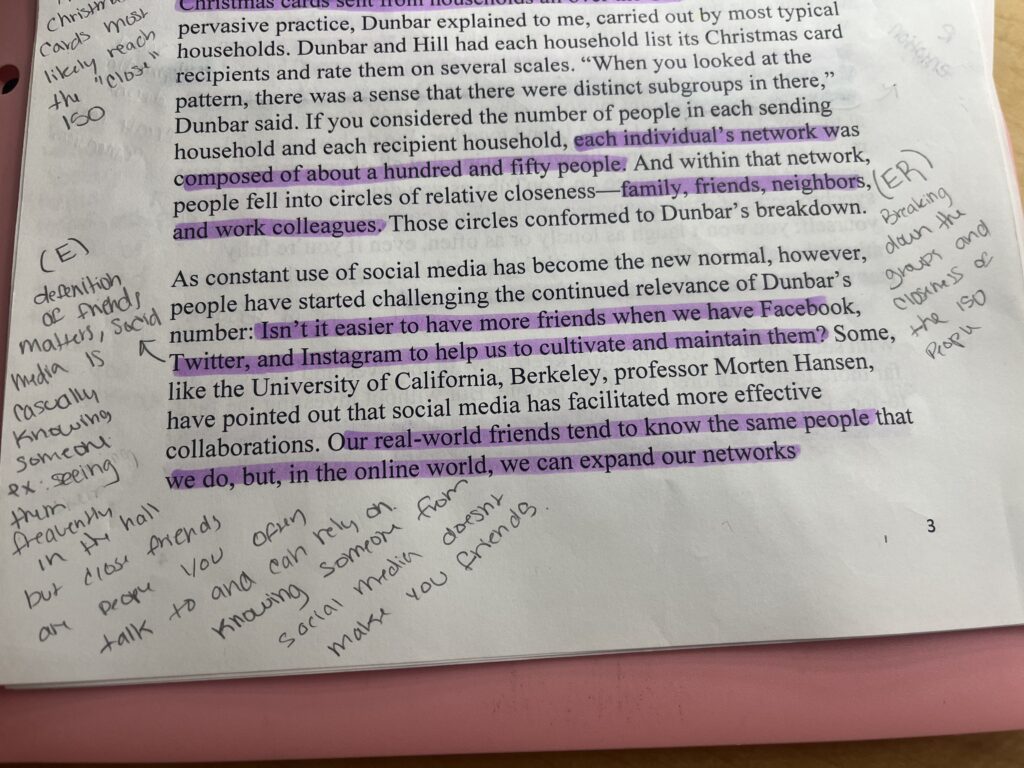
During the first five weeks of writing, I experimented with new active reading strategies that improved my skills. I’ve grown to realize that different strategies work better for me. At first I didn’t feel confident annotating “The Hawk.” I read, highlighted, and took notes on what felt important. I later used the class discussion to get a better understanding. Those annotations weren’t helpful enough to understand why I highlighted the sentence. I would have to stop and read to remember. For our next writing assignment we got an annotation guide, which I’m familiar with from high school. I read through Konnikova’s piece “The Limits of Friendships” the first time without the guide and did my own annotations, but when I read it again with the guide I found other meanings in the reading and furthered my understanding. An example of this strategy working for me I find on the last paragraph of page 3. I used (E) meaning extending, and brought out more of the writer’s ideas. After this piece I feel a lot more confident with annotating and understanding writing, and knowing that the notes I take aren’t right or wrong based on certain expectations. These annotations also helped make my reading responses more in depth, which I feel confident in but know there are areas to improve.
We also learned about source integration in many different ways. While I am familiar with all of this, we didn’t practice enough in high school for me to be confident in it. I had the most past experience with summary although I also feel that is the area I have most improved. We use summary and quote in almost all of our reading responses. Paraphrasing is something I didn’t learn much about in the past, but I still feel I haven’t worked with this enough to have a better understanding. Quoting is the area I see I could improve most, I struggle with introducing quotes in a way that makes sense. although the “They Say I Say” text provides templates that have helped.


The peer review process we learned and practiced was helpful as a way to view my own ideas from a different perspective. Having someone else read and annotate my piece gives me a better understanding on how specific or not specific I am. For example, at the beginning of my writing I was very specific and explained scenarios where others might relate to. I said, “The annotations are supposed to give me a better understanding of the writing, but somehow my annotations were wrong.” This example from my high school experience is specific because it gives the reader something to relate to, which I got positive feedback on in my peer review. Later in my writing I got a lot of feedback to be more specific, for example, I talked about the brief annotation guide we used to guide our reading, but I didn’t state any specific examples of the annotation styles. The feedback I received from peer review is helpful in my revision process because it gives me an idea of what areas I need to clarify and be more specific, with examples.
When peer reviewing someone else’s work, I sometimes remember things I forgot on my own work, or get ideas of areas I can improve. The biggest challenge I face when practicing peer review is finding areas the writer can improve, other than being more specific, most things don’t stick out that might need to be changed.
© 2026 Ava Bishop's e-Portfolio
Theme by Anders Noren — Up ↑
